In Leviticus 16, the word Azazel is used four times. In fact, Azazel is only used four times in the entire Bible, all in Leviticus 16. This wouldn’t be too big a deal, except that this chapter describes the ritual process surrounding the Day of Atonement. Yes, that Day of Atonement, the one that Jesus ultimately fulfills once and for all on the cross.
On the Day of Atonement, two goats are selected. The high priest casts lots and one goat is set aside for the Lord, and the other goat is set aside for Azazel. Huh? Who or what is Azazel?
It turns out that there are three or four major options. The first option takes the original Hebrew word and breaks it up into parts, one part meaning “goat” or “goats,” and the other part meaning “to go away.” This is where the idea of scapegoat comes from, the Goat that Went Away. The second major option is that Azazel is the proper name for a demon of the wilderness, maybe even the Devil himself. Apparently, an increasing number of scholars today are leaning toward the second option, which is why the ESV Bible renders the proper noun Azazel rather than using the generic word scapegoat as the NASB or KJV does.
This brings to light one of the most difficult things I have faced as I have gone through the last six years of theological education, namely, the Bible often seems to create more questions than it answers. Most certainly, the Bible asks more questions than the average church attendee wants to think it does. The Bible is not a bunch of pithy sayings used to comfort people or bang people over the head with. It is the written word, the revelation of the Living God, who is infinite, and therefore infinitely complex.
I am not advocating some pomo idea that the Bible can hold contradictory truths and that be OK. Instead, I am recognizing that we look through a glass darkly and there is much we don’t understand. God is infinite and explodes all the boxes we try to put him in. His Bible, his word is the same way. It reveals an infinite God and exposes a bunch of questions along the way.
So, what to do? How do we handle all these questions? Some days I attack them with relish, believing wholeheartedly what my friend loves to say, “Apparent contradictions are theological goldmines.” Other days, I can waver in my faith and wonder how there can be so many disparate views and understandings of the same passage.
It is at those times that I have to stop and center myself on the truths in the Bible that are rock solid, the truths that are the core of my faith and are so solid no question can assail their walls.
The Resurrection.
Paul understood the crux of this when wrote to the Corinthians, “And if Christ has not been raised, your faith is futile and you are still in your sins. Then those also who have fallen asleep in Christ have perished. If in this life only we have hoped in Christ, we are of all people most to be pitied.” A few paragraphs later he added the oft quoted, “If the dead are not raised, ‘Let us eat and drink, for tomorrow we die.’”
The core reality that I hold on to is the resurrection of Jesus Christ. There is no other truth like this truth. There is no other defining reality that separates the sheep from the goats like this reality. There is no other historical event upon which belief determines the eternal destiny of souls. That Jesus Christ be raised is the defining moment in history upon which everything balances.
So, while I still question Azazel, I remember that my faith is not dependent on who or what that term refers to. I can worship a God who is complex and deep, whose words are wrought with layers of meaning, and rejoice in both the complexity and the simplicity of who he is.
Monday, May 09, 2011

Thursday, May 05, 2011
The Evident Wonder of God's Great Provision
“Sometimes it’s books or songs that tear away at the carefully crafted shackles we have allowed around our wrists, the bonds that blind us to the evident wonder of God’s great provision. Sometimes it’s a holy encounter with a saint. Sometimes it’s math, basketball, corn dogs, Victoria Falls, making love, babies, adoption, a painting, a person failing well, a fancy car, poetry, or water, or bread, or wine.”
—I’M FINITE, HOW ARE YOU?, by S. D. Smith
—I’M FINITE, HOW ARE YOU?, by S. D. Smith
Tuesday, May 03, 2011
Congratulations! Your First 10k!
My godly bride took up running two years ago. I have been chasing her around the house for over twenty years; now I have to actually get outside to try and catch her!
She ran her first 10k race this last Saturday. I am so proud of all her hard work. She finished in the top 32 percent in her age bracket. Don’t let that fool you. She also finished in the top 32 percent of women 10 years younger. She rocks.

You can check out the wear and tear on her shoes over the last two years here.
I love you, my bride. Way to go!
She ran her first 10k race this last Saturday. I am so proud of all her hard work. She finished in the top 32 percent in her age bracket. Don’t let that fool you. She also finished in the top 32 percent of women 10 years younger. She rocks.

You can check out the wear and tear on her shoes over the last two years here.
I love you, my bride. Way to go!
Yikes! Gas Prices Too High!
I am thankful that a I have the opportunity to work from home a day or two per week. In January an average fill-up at the gas station ran me $53. Today it is running $72 per tank.
We have noticed a similar increase in food prices. Prices have increased somewhat dramatically from week to week, while we are purchasing the same set of staple foods. Between food and gas, our family of six is feeling the pinch. What choices do I have to save money?
1. Drive less. Plan trips accordingly. Work from home.
2. Buy a more gas efficient vehicle. Hmmm. Not very practical.
3. Ride a bike. It’s cold 9 months out of 12.
4. Eat less. Don’t let my 13-year old son have free reign over the fridge.
5. Use more coupons. Lots of work; could be helpful.
6. Charge my kids rent. Child labor laws?
7. Get a second job. Not realistic.
8. ????
What are you doing to fend off higher prices at the grocery store and the gas pump?
We have noticed a similar increase in food prices. Prices have increased somewhat dramatically from week to week, while we are purchasing the same set of staple foods. Between food and gas, our family of six is feeling the pinch. What choices do I have to save money?
1. Drive less. Plan trips accordingly. Work from home.
2. Buy a more gas efficient vehicle. Hmmm. Not very practical.
3. Ride a bike. It’s cold 9 months out of 12.
4. Eat less. Don’t let my 13-year old son have free reign over the fridge.
5. Use more coupons. Lots of work; could be helpful.
6. Charge my kids rent. Child labor laws?
7. Get a second job. Not realistic.
8. ????
What are you doing to fend off higher prices at the grocery store and the gas pump?
301 Posts
The post just before this one, titled “Your Help is Found in Christ,” was the 300th post on this blog.
I didn’t think about it or plan it, but it is fitting that a milestone, small or big, be accented by the saving work of our Lord Jesus Christ.
“So, whether you eat or drink, or whatever you do, do all to the glory of God” (1 Corinthians 10:31).
I didn’t think about it or plan it, but it is fitting that a milestone, small or big, be accented by the saving work of our Lord Jesus Christ.
“So, whether you eat or drink, or whatever you do, do all to the glory of God” (1 Corinthians 10:31).
Your Help is Found in Christ
I have a very dear friend who has suffered much. He is the most joyful man I know. I am reposting his blog entry from today because his quote of Spurgeon is so good. You should subscribe to his blog and see a man who knows what it means to be “sorrowful, yet always rejoicing.”
I do not know what you need, but I do know Christ has it. I do not know the full of your disease, but I do know Christ is the physician who can meet it. I do not know how hard and stubborn and stolid and ignorant and blind and dead your nature may be, but I do know that “Christ is able to save unto the uttermost them that come unto God by Him.” What you are has nothing to do with the question, except that it is the mischief to be undone. The true answer to the question of how you are to be saved lies yonder in the bleeding body of the immaculate Lamb of God! Christ has all salvation in Himself. He is Alpha, He is Omega. He does not begin to save and leave you to perish, nor does He offer to complete what you must first begin. . .If I might only have it to utter one sentence, it would be this one, “Your help is found in Christ.” As for you, there never can be found anything hopeful in your human nature. It is death itself! It is rottenness and corruption. Turn, turn your eyes away from this despairing mass of black depravity and look to Christ! He is the sacrifice for human guilt. His is the righteousness that covers men and makes them acceptable before the Lord!—Charles H. Spurgeon, Memory: The Handmaid of Hope, delivered October 15, 1865.
Friday, April 29, 2011
A Lesson Learned
This is a repost from Justin Taylor’s Between Two Worlds:
From an interview with with Albert Mohler in TableTalk magazine:
Although there are many, is there one lesson the Lord has taught you that you would care to share with us?
I think the one great lesson the Lord has taught me over these years is that the importance of the family and the local congregation supersedes every other relationship to which the Christian is called. Christians demonstrate the glory of God and the power of the gospel by the way we marry and stay married, by the way we raise our children, by the way we love each other, and by the way we live faithfully in the congregation of believers. In the end, I fear that far too much energy is devoted to and far too many hopes are invested in institutions, programs, and projects that will not last. The centrality of Christ’s purpose to glorify himself in His church and the blessings of God that are directed to the precious gift of the family — these far exceed our other allegiances.(HT: JT)
The Incredibles Sequel
Did you hear that they were casting for the live action version of The Incredibles?


Friday, April 22, 2011
Pulchritude
“A paradoxical noun because it means beauty but is itself one of the ugliest words in the language. Same goes for the adjectival form pulchritudinous. They’re part of a tiny elite cadre of words that possess the very opposite of the qualities they denote. Diminutive, big, foreign, fancy (adjective), colloquialism, and monosyllabic are some others; there are at least a dozen more. Inviting your school-age kids to list as many paradoxical words as they can is a neat way to deepen their relationship to English and help them see that words are both symbols for things and very real things themselves.”
I found this brief, interesting paragraph in the Mac OS X Dictionary program when I looked up “Beauty” in the Thesaurus. It was cool enough to post. I love the thought that words are “both symbols for things and very real things themselves.”
I found this brief, interesting paragraph in the Mac OS X Dictionary program when I looked up “Beauty” in the Thesaurus. It was cool enough to post. I love the thought that words are “both symbols for things and very real things themselves.”
Visitor

Wendy caught this bird on the deck yesterday. The snow had melted and the birds were out.
Does anyone know what kind of bird this is? We couldn't find our bird book today....
Grilling Equipment Recommendations
Recently, a buddy of mine told me that he wanted to buy a grill and asked me what he should get and if there were any accessories he should look for. The following were my recommendations for him.
To begin with, there is only one charcoal grill: Weber. The line of Kettle style grills has various flavors, but the classic is the 22.5" Kettle Grill, which can be purchased at HomeDepot, Target, or most hardware stores. This is the same grill that I have had for the last ten years.
If money is less of a problem, the next step up the line is nice because the ash holder is cleaner to use. It is the same grill, but with a few extra features. There are Weber charcoal grills with more features than, but the price keeps going up. Really, the bottom of the line grill is perfectly acceptable for almost all home grilling.
However, lately, I have been dreaming of getting a different style grill, mostly because I like cooking for larger groups, and my beloved Weber is not big enough, even if I got the biggest (26.6" diameter, ash holder, and thermometer), which is too expensive. I would like to explore longer, slower, smokier, cooking, so I have my eyes on something new.
Accessories: A few essentials
Chimney Starter. This is an essential tool for starting a fire without lighter fluid. Never use lighter fluid. This is way better and it will last for years. Just add newspaper, charcoal, and fire.
Regarding charcoal, you can get some at any grocery store. The best brand is Kingsford, in the blue bag. Don’t get any charcoal with lighter fluid built in—it is not needed and it screws up the taste.
Get a good grate brush and simple food tools. There are fancier and more expensive tool sets, and there are cheaper sets, but these have been my favorite. They are light-weight, which makes them easy to use and clean. They are sold by Target for Weber (already on the shelves), but you can see them at this Amazon link.
Grilling book. This is a great book to start with. It helps you understand how to start a fire, tell when the fire is hot enough, judge the cooking heat, and gives you tips on cooking, as well as a bunch of great recipes. Basically, you can not go wrong if you get a grilling cookbook by Jamie Purviance.
And of course, an Apple fanboy like me can’t live without a Weber iPhone app, which is only $4.99 and all the recipes are from Jamie’s books.
Get a good grate brush and simple food tools. There are fancier and more expensive tool sets, and there are cheaper sets, but these have been my favorite. They are light-weight, which makes them easy to use and clean. They are sold by Target for Weber (already on the shelves), but you can see them at this Amazon link.
Grilling book. This is a great book to start with. It helps you understand how to start a fire, tell when the fire is hot enough, judge the cooking heat, and gives you tips on cooking, as well as a bunch of great recipes. Basically, you can not go wrong if you get a grilling cookbook by Jamie Purviance.
And of course, an Apple fanboy like me can’t live without a Weber iPhone app, which is only $4.99 and all the recipes are from Jamie’s books.
Finally, at least one glove is necessary. Cooking with live fire can get hot, and it is nice not to worry about burning your arm hairs. A glove is not essential, but handy. I have this one, but I want this one.
I use this stuff day in and day out (tonight were more barbecued buffalo wings; new recipe, super hot). Don’t be fooled by the weekend warrior grillers who have all the fanciest gadgets. Simple, light, clean, and easy so you put more energy into great food.
I use this stuff day in and day out (tonight were more barbecued buffalo wings; new recipe, super hot). Don’t be fooled by the weekend warrior grillers who have all the fanciest gadgets. Simple, light, clean, and easy so you put more energy into great food.
Wednesday, April 20, 2011
Funny
Douglas Wilson points his acerbic wit towards “seven memes for keeping Christians in their place” in a post today. All of them are good and worth thinking through. But, I found number six to be particularly humorous:
6. Biblical faith stifles and deadens the aesthetic soul.
I will not say much here, except to note that I do not believe that the builders of Salisbury Cathedral, the composer of the Brandenburg concertos, the painter of The Night Watch, or the writer of Paradise Lost, have anything to apologize for in the thin shade of Kanye West, John Cage, Jackson Pollock, Walter Gropius, or Barry Manilow.Read the whole thing.
Wednesday, April 13, 2011
As he deals with us.
“Even so, we must face the fact that God’s interaction with his creation is not always constructive and restorative but is often shockingly destructive. It is true that the destruction always precedes some kind of renewal, but it is destruction all the same, and while we can come up with the comforting scenarios in which we do the same kind of thing — controlled burns in forest management and farming, for instance — it would be best not to allegorize too readily. God loves his creation, but he deals with it in ways that, to us, are sometimes indistinguishable from hatred. As he deals with us.”
— Alan Jacobs, “Blessed Are the Green of Heart,” in Wayfaring, p. 126
— Alan Jacobs, “Blessed Are the Green of Heart,” in Wayfaring, p. 126
Sunday, April 10, 2011
We're bookish

Wife
The Holy Bible, by the Holy Spirit through various authors
The Battle of the Labyrinth, by Rick Riordan
A Little Princess, by Frances Hodgson Burnett
My Life in France, by Julia Child and Alex Prud’Homme
Oldest Daughter
The Holy Bible, by the Holy Spirit through various authors
The Red Badge of Courage, by Stephen Crane
The Treaty of Versailles
Emily Climbs, by L. M. Montgomery
Christianity and Liberalism, by J. Gresham Machen
The Mystery of the Laughing Shadow, by William Arden
Peter and the Secret of Rundoon, by Dave Barry and Ridley Pearson
Son
The Holy Bible, by the Holy Spirit through various authors
The Penultimate Peril, A Series of Unfortunate Events, Book 12, by Lemony Snicket
Sir Gawain and the Greek Knight, translated by J. R. R. Tolkien
Henry V, by Shakespeare
The Chestnut King, by N. D. Wilson (again)
A Soldier’s Story, by Omar N. Bradley
Middle Daughter
The Holy Bible, by the Holy Spirit through various authors
The Red Pyramid, by Rick Riordan
Emily of New Moon, by L. M. Montgomery
My Upmost for His Highest, by Oswald Chambers
Think, by John Piper
Youngest Daughter
The Holy Bible, by the Holy Spirit through various authors
Harry Potter and the Chamber of Secrets, by J. K. Rowling
Dangerous Journey, by Oliver Hunkin
Saturday, April 09, 2011
Grilled Chicken, Smoked Gouda, and Arugula Panini
There is a delightful pleasure derived when serving a meal that is really enjoyed by those eating it. After last week’s rookie but successful run at a barbecued chicken cordon bleu sandwich, tonight we attempted a chicken sandwich that required a bit more finesse. It was fantastic.
I am not trying to overly spiritualize making a meal, but there is something right about Christians gathered together for fellowship over well cooked food; and not just the eating part, but spending the afternoon lighting the fire, preparing the ingredients, cooking and serving the food, all of which works together—in the ebb and flow of conversation—to be a Christian joy. OK, enough said.
Since last Saturday’s chicken sandwiches were a success, we thought we would try something new tonight with company: Grill chicken panini with smoked gouda and arugula. Preparing the food was amazingly simple, but the grilling did require a few techniques beyond slamming some meat on and flipping it over high heat with barbecue sauce until it’s burned.
Sorry, that sounds terribly derogatory. But, I have learned that the majority of grilling well is managing the fire. Learning to use just the right amount of briquettes, placing them to create zones of heat, and being patient for the amount of heat to raise (or lower) to the correct temperature zone is critical. Oh, and keep the lid on and don’t flip the food more than once or twice.
I pounded down the chicken breasts to less than 1/2" thick (smacking chicken with a cast iron pan is kind of fun), smeared them with olive oil, chili powder, kosher salt, and black pepper, and then grilled them over direct high heat for 3–5 minutes per side, lid closed as much as possible, and flipping them only once if possible. After taking the finished chicken inside, and while the fire burned itself towards low heat, I smeared olive oil on one side of a slice of tuscan bread, placed the chicken breasts, smoked gouda, and arugula on the bread, spread a mixture of mayonnaise and dijon mustard on the second slice of bread, and put the sandwiches together. I smeared more olive oil on the top of the second piece of bread and headed back out to the grill.
Once the fire was at low heat, I placed the sandwiches on the grill and covered them with a baking sheet and placed a large, heavy object (I used an empty cast iron dutch oven) on top of the baking sheet, squishing the sandwiches panini style. After about 3 minutes, I uncovered them, flipped the sandwiches, replaced the baking sheet and weight, and toasted the other side.
Frankly, they were fabulous. These are definitely going in the “we should do these again department.”
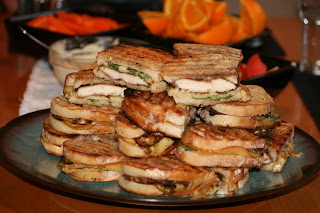
Oh, and did I say that because we had special friends over tonight, we topped off the evening with homemade cheesecake?

Heavenly, indeed.
I am not trying to overly spiritualize making a meal, but there is something right about Christians gathered together for fellowship over well cooked food; and not just the eating part, but spending the afternoon lighting the fire, preparing the ingredients, cooking and serving the food, all of which works together—in the ebb and flow of conversation—to be a Christian joy. OK, enough said.
Since last Saturday’s chicken sandwiches were a success, we thought we would try something new tonight with company: Grill chicken panini with smoked gouda and arugula. Preparing the food was amazingly simple, but the grilling did require a few techniques beyond slamming some meat on and flipping it over high heat with barbecue sauce until it’s burned.
Sorry, that sounds terribly derogatory. But, I have learned that the majority of grilling well is managing the fire. Learning to use just the right amount of briquettes, placing them to create zones of heat, and being patient for the amount of heat to raise (or lower) to the correct temperature zone is critical. Oh, and keep the lid on and don’t flip the food more than once or twice.
I pounded down the chicken breasts to less than 1/2" thick (smacking chicken with a cast iron pan is kind of fun), smeared them with olive oil, chili powder, kosher salt, and black pepper, and then grilled them over direct high heat for 3–5 minutes per side, lid closed as much as possible, and flipping them only once if possible. After taking the finished chicken inside, and while the fire burned itself towards low heat, I smeared olive oil on one side of a slice of tuscan bread, placed the chicken breasts, smoked gouda, and arugula on the bread, spread a mixture of mayonnaise and dijon mustard on the second slice of bread, and put the sandwiches together. I smeared more olive oil on the top of the second piece of bread and headed back out to the grill.
Once the fire was at low heat, I placed the sandwiches on the grill and covered them with a baking sheet and placed a large, heavy object (I used an empty cast iron dutch oven) on top of the baking sheet, squishing the sandwiches panini style. After about 3 minutes, I uncovered them, flipped the sandwiches, replaced the baking sheet and weight, and toasted the other side.
Frankly, they were fabulous. These are definitely going in the “we should do these again department.”

Oh, and did I say that because we had special friends over tonight, we topped off the evening with homemade cheesecake?

Heavenly, indeed.
Last Saturday's Barbecue
I was hungry last Saturday. Usually when I’m hungry that means I want to make something that would taste good. Well, that has turned out to be the main reason I grill. The solution for last Saturday’s problem was a grilled chicken sandwich concoction.
Since I was really hungry, I decided to grill two things at the same time. One was the buffalo wings I have mentioned before. The other was what I call chicken cordon bleu, but I have no idea if that is an accurate title.
I prepared 25 chicken wings with olive oil, kosher salt, black pepper, and a bit of cayenne pepper and put them in the fridge. I got the barbecue out, set it up, and lit the chimney with only about 3/4 the normal amount of briquettes. I knew that I needed only a medium heat fire, so no sense in using more Kingsford than needed.
While the fire was getting ready, I prepared the chicken breasts. I was hungry for wings and my chicken sandwich, but Wendy informed me that she wanted caesar salad with chicken. Three completely separate dinners? How to do that?
The wings were already started and easy enough to do. I decided to do double duty for the caesar salad and sandwiches by preparing the chicken breasts the same for each. I made a paste by mixing equal parts dijon mustard with olive oil, then added chili powder and black pepper. I smothered this paste all over eight chicken breasts and let them sit until the fire was ready.
I poured out the briquettes from the chimney and arranged the fire in the grill for two-zone heat. Then I grilled all the wings and breasts over medium heat with the lid closed as much as possible and only turning everything once.
I wrapped a bunch of bacon in foil and threw it on the grill when I pulled off the chicken. By this time the grill was at low heat, but it was enough to cook the bacon while I made the wings sauce. Wendy cut up a bunch of romaine lettuce and Chase set the table.
Once the bacon was done, we all prayed and began adding food to our plates. Wendy cut up some of the dijon-mustardy chicken into her caesar salad. Amazingly the hint of dijon on the chicken added a subtle taste to the caesar salad. Quite good.
For my chicken cordon bleu sandwich, I put a chicken breast on some tuscan bread, added bacon and swiss cheese. Then I slathered some dijon mustard on one side of the bread and toasted it all in the oven.
It was excellent. Sorry I don't have any pictures. You will just have to trust me.
By the way, if you are an astute reader, you will notice how much dijon mustard I used in preparing last Saturday's dinner. I am really enjoying dijon mustard lately and have found it be a very tasty ingredient.
If you read this far, you are either my mother, or a very nice person. Or both, of course. Hi, mom! But your main reward for reading this far, is to understand why I attempted to barbecue what we had tonight. Since my concocted sandwiches last week were a success, we tried to make panini sandwiches worthy of competition with Paneras.
Since I was really hungry, I decided to grill two things at the same time. One was the buffalo wings I have mentioned before. The other was what I call chicken cordon bleu, but I have no idea if that is an accurate title.
I prepared 25 chicken wings with olive oil, kosher salt, black pepper, and a bit of cayenne pepper and put them in the fridge. I got the barbecue out, set it up, and lit the chimney with only about 3/4 the normal amount of briquettes. I knew that I needed only a medium heat fire, so no sense in using more Kingsford than needed.
While the fire was getting ready, I prepared the chicken breasts. I was hungry for wings and my chicken sandwich, but Wendy informed me that she wanted caesar salad with chicken. Three completely separate dinners? How to do that?
The wings were already started and easy enough to do. I decided to do double duty for the caesar salad and sandwiches by preparing the chicken breasts the same for each. I made a paste by mixing equal parts dijon mustard with olive oil, then added chili powder and black pepper. I smothered this paste all over eight chicken breasts and let them sit until the fire was ready.
I poured out the briquettes from the chimney and arranged the fire in the grill for two-zone heat. Then I grilled all the wings and breasts over medium heat with the lid closed as much as possible and only turning everything once.
I wrapped a bunch of bacon in foil and threw it on the grill when I pulled off the chicken. By this time the grill was at low heat, but it was enough to cook the bacon while I made the wings sauce. Wendy cut up a bunch of romaine lettuce and Chase set the table.
Once the bacon was done, we all prayed and began adding food to our plates. Wendy cut up some of the dijon-mustardy chicken into her caesar salad. Amazingly the hint of dijon on the chicken added a subtle taste to the caesar salad. Quite good.
For my chicken cordon bleu sandwich, I put a chicken breast on some tuscan bread, added bacon and swiss cheese. Then I slathered some dijon mustard on one side of the bread and toasted it all in the oven.
It was excellent. Sorry I don't have any pictures. You will just have to trust me.
By the way, if you are an astute reader, you will notice how much dijon mustard I used in preparing last Saturday's dinner. I am really enjoying dijon mustard lately and have found it be a very tasty ingredient.
If you read this far, you are either my mother, or a very nice person. Or both, of course. Hi, mom! But your main reward for reading this far, is to understand why I attempted to barbecue what we had tonight. Since my concocted sandwiches last week were a success, we tried to make panini sandwiches worthy of competition with Paneras.
Friday, April 08, 2011
The Greater Need of a Theology of Suffering
I had a thought this morning as I was trying to wake up and get out of bed. Strange, I know.
“It seems likely that an unbiblical response to suffering in the Christian life is a much larger threat to the evangelical church—as undefined and squirmy as that term is—than Rob Bell’s heterodoxy. Therefore, I wish that the Christian leaders and pastors spent more time developing solid biblical and theological arguments for, winsomely preaching, and patiently walking people through a theology of suffering.”Granted, there are those who do. But there are also those who do not. People distrusting God and walking away from him due to a poor understanding of suffering in the Christian life seems like a monumental task for pastors to get right. My esteem of pastors who do get it right is very high, indeed.
Alphabet Soup
Mom, and any one else stumbling by who knows my friend Joe, check out the latest video of his son and the alphabet.
Thursday, April 07, 2011
The Best of All Fairy Tales
This quote is from a blog post advertising a Christian artist conference, and furthermore, from The Jesus Storybook Bible, but it is a great quote nonetheless:
“The Bible is most of all a Story. It’s an adventure story about a young Hero who comes from a far country to win back his lost treasure. It’s a love story about a brave Prince who leaves his palace, his throne - everything - to rescue the one he loves. It’s like the most wonderful of fairy tales that has come true in real life!”I love good fairy tales.
Saturday, April 02, 2011
Seeing Sin Rightly
Two things came together yesterday to cause this post. The first was a paragraph quoted by Alan Jacobs on his common-book website, More than 95 Theses, and re-tweeted by my friend. Here’s the quote:
If a man lusts in his heart, what are the consequences? If a man yells at his children or struggles with pride or wastes time when he should be working or is not grateful to the Lord for all the good gifts he has received, how does he feel the weight, the significance of his sin?
If a woman gossips to her friends or doesn’t return the five dollars the clerk mistakenly gave her at the checkout counter or doesn’t honor her husband or isn’t thankful that the Lord has sustained her family for another day, how does she feel the force of her sin?
The reality, I think, for Christians in this modern era, is that we don’t, no, we can’t, comprehend the hideousness, the disgust, awfulness of our sin, until we understand that sin is hideous, disgusting, and awful. How often have you heard someone cluck about so-and-so, “He won’t really wake-up until he hits bottom”? The point is that modern people seemingly have to be confronted with dire consequences of sin before they realize the seriousness of the sin. A woman has to divorce her husband before he realizes that his addiction to pornography is hideous. A man has to go to jail before he realizes that cheating on taxes is a breaking of Jesus’ command.
The second thing was reading from the first chapter of Leviticus. Note the use of the personal pronouns in these verses.
He shall kill the bull before the Lord.
I had previously thought the priest did all the killing. How do I know it is the sinner and not the priest? Because of the pronouns. “He shall kill the bull before the Lord, and Aaron’s sons the priest shall bring the blood….” In the first paragraph God says, “When any one of you brings an offering to the Lord…. If his offering is a burnt offering….He shall bring it to the entrance…, that he may be accepted….He shall lay his hand on the head….Then he shall kill the bull before the Lord.”
Aaron’s sons aren’t doing the killing, they are catching the blood and flinging it against the alter, but the sinner is doing the slaughter. Keep reading in this chapter and see how in each case the sinner kills the animal, except for turtledoves and pigeons, where the priest twists off its head. (I talked with the BCS OT professor and he tentatively agreed with me. Granted, Hebrew pronouns can be difficult, but it seems that the sinner leads the animal, kills it, and from then on the priests do all the rest of the ritual work.)
When was the last time you slit an animal’s throat?
So, putting these things together, it seems that the sacrificial system had a built-in way to help people feel the hideousness, the disgust, the awfulness, the weight of sin, in a way we moderns can’t comprehend. Some animal really had to die when they committed sin.
The truth, for a New Testament Christian, is that someone had to die when we sin as well. This One’s death was hideous, disgusting, and awful. The weight of his death brought darkness upon the earth for hours and tore the veil between the people and the Holy of Holies. The weight of his death broke open graves and caused the dead to walk alive. The force of his death changed the reality of the universe from that point forward. His death is the determining factor for the fate of humanity.
Jesus is the spotless lamb upon whom believing Christians placed their hands and drew the knife across his throat.
Praise God.
Hate sin.
“The Lenten season is devoted especially to what the theologians call contrition, and so every day in Lent a prayer is said in which we ask God to give us ‘contrite hearts.’ Contrite, as you know, is a word translated from Latin, meaning crushed or pulverized. Now modern people complain that there is too much of that note in our Prayer Book. They do not wish their hearts to be pulverized, and they do not feel that they can sincerely say that they are ‘miserable offenders.’ I once knew a regular churchgoer who never repeated the words, ‘the burden of them (i.e. his sins) is intolerable’, because he did not feel that they were intolerable. But he was not understanding the words. I think the Prayer Book is very seldom talking primarily about our feelings; that is (I think) the first mistake we’re apt to make about these words ‘we are miserable offenders.’ I do not think whether we are feeling miserable or not matters. I think it is using the word miserable in the old sense — meaning an object of pity. That a person can be a proper object of pity when he is not feeling miserable, you can easily understand if you imagine yourself looking down from a height on two crowded express trains that are traveling towards one another along the same line at 60 miles an hour. You can see that in forty seconds there will be a head-on collision. I think it would be very natural to say about the passengers of these trains, that they were objects of pity. This would not mean that they felt miserable themselves; but they would certainly be proper objects of pity. I think that is the sense in which to take the word ‘miserable.’ The Prayer Book does not mean that we should feel miserable but that if we could see things from a sufficient height above we should all realize that we are in fact proper objects of pity.”While this quote is really directed at the reception of the Prayer Book, what is says about modern people is worth noting. How much of the reality that modern people “do not wish their hearts to be pulverized,” and “do not feel that they can sincerely say that they are ‘miserable offenders’” is because we, modern people, do not feel the horror, yes, horror of sin.
If a man lusts in his heart, what are the consequences? If a man yells at his children or struggles with pride or wastes time when he should be working or is not grateful to the Lord for all the good gifts he has received, how does he feel the weight, the significance of his sin?
If a woman gossips to her friends or doesn’t return the five dollars the clerk mistakenly gave her at the checkout counter or doesn’t honor her husband or isn’t thankful that the Lord has sustained her family for another day, how does she feel the force of her sin?
The reality, I think, for Christians in this modern era, is that we don’t, no, we can’t, comprehend the hideousness, the disgust, awfulness of our sin, until we understand that sin is hideous, disgusting, and awful. How often have you heard someone cluck about so-and-so, “He won’t really wake-up until he hits bottom”? The point is that modern people seemingly have to be confronted with dire consequences of sin before they realize the seriousness of the sin. A woman has to divorce her husband before he realizes that his addiction to pornography is hideous. A man has to go to jail before he realizes that cheating on taxes is a breaking of Jesus’ command.
The second thing was reading from the first chapter of Leviticus. Note the use of the personal pronouns in these verses.
The LORD called Moses and spoke to him from the tent of meeting, saying, “Speak to the people of Israel and say to them, When any one of you brings an offering to the LORD, you shall bring your offering of livestock from the herd or from the flock.
“If his offering is a burnt offering from the herd, he shall offer a male without blemish. He shall bring it to the entrance of the tent of meeting, that he may be accepted before the LORD. He shall lay his hand on the head of the burnt offering, and it shall be accepted for him to make atonement for him. Then he shall kill the bull before the LORD, and Aaron’s sons the priests shall bring the blood and throw the blood against the sides of the altar that is at the entrance of the tent of meeting. Then he shall flay the burnt offering and cut it into pieces, and the sons of Aaron the priest shall put fire on the altar and arrange wood on the fire” (Leviticus 1:1–7).What shocked me was that the person who leads the male animal from the herd to the tent of meeting is the sinner. The person who lays his hands on the head of that animal is the sinner. The person who takes the knife in his hand and with a nervous jerk tries to slice the animal’s throat, feeling its warms blood spill out over his hands and the animal jump and kick and try to get free, all the while getting weaker as its life-blood drains away into the priests pot.
He shall kill the bull before the Lord.
I had previously thought the priest did all the killing. How do I know it is the sinner and not the priest? Because of the pronouns. “He shall kill the bull before the Lord, and Aaron’s sons the priest shall bring the blood….” In the first paragraph God says, “When any one of you brings an offering to the Lord…. If his offering is a burnt offering….He shall bring it to the entrance…, that he may be accepted….He shall lay his hand on the head….Then he shall kill the bull before the Lord.”
Aaron’s sons aren’t doing the killing, they are catching the blood and flinging it against the alter, but the sinner is doing the slaughter. Keep reading in this chapter and see how in each case the sinner kills the animal, except for turtledoves and pigeons, where the priest twists off its head. (I talked with the BCS OT professor and he tentatively agreed with me. Granted, Hebrew pronouns can be difficult, but it seems that the sinner leads the animal, kills it, and from then on the priests do all the rest of the ritual work.)
When was the last time you slit an animal’s throat?
So, putting these things together, it seems that the sacrificial system had a built-in way to help people feel the hideousness, the disgust, the awfulness, the weight of sin, in a way we moderns can’t comprehend. Some animal really had to die when they committed sin.
The truth, for a New Testament Christian, is that someone had to die when we sin as well. This One’s death was hideous, disgusting, and awful. The weight of his death brought darkness upon the earth for hours and tore the veil between the people and the Holy of Holies. The weight of his death broke open graves and caused the dead to walk alive. The force of his death changed the reality of the universe from that point forward. His death is the determining factor for the fate of humanity.
Jesus is the spotless lamb upon whom believing Christians placed their hands and drew the knife across his throat.
Praise God.
Hate sin.
Tuesday, March 22, 2011
Galatians Commentary by Schreiner
I have written before about Tom Schreiner being one of my heroes. It is good to have heroes. It is also good when they are mild-mannered scholars.
I have not written about the fact that every good preaching pastor should have serious, rigorous, pastoral, commentaries on their shelf that they see as their “go-to” commentary.
It is really cool when my hero writes such a commentary. In fact, he has written three on deep, rich, and difficult Bible books (at this level, they are all difficult). Schreiner’s commentary on Romans was the first commentary I ever bought—a story I love to tell about God’s providence in my life.
Recently, a good friend gave me the Galatians commentary as a gift. It holds the pride of place among my Galatians commentaries.
Guy Waters over at Reformation21 just reviewed Schreiner’s work. Here is his conclusion:
I have not written about the fact that every good preaching pastor should have serious, rigorous, pastoral, commentaries on their shelf that they see as their “go-to” commentary.
It is really cool when my hero writes such a commentary. In fact, he has written three on deep, rich, and difficult Bible books (at this level, they are all difficult). Schreiner’s commentary on Romans was the first commentary I ever bought—a story I love to tell about God’s providence in my life.
Recently, a good friend gave me the Galatians commentary as a gift. It holds the pride of place among my Galatians commentaries.
Guy Waters over at Reformation21 just reviewed Schreiner’s work. Here is his conclusion:
As one who annually teaches at the seminary level a course in the exegesis of the Greek text of Galatians, I have publicly lamented before my students the absence of a readable, recent, post-NPP, exegetically-rigorous, Reformationally-theological commentary on the Greek text of Galatians. Many of the theologically solid commentaries are older or do not engage the Greek text. Many of the exegetically rigorous commentaries, even the recent ones, give me theological pause. Finally, I can tell my students that if they ever preach or teach Paul’s epistle to the Galatians, then Schreiner’s Galatians needs to have a place on their study shelf. This work has the double benefit not only of yielding much exegetical fruit from the Epistle to the Galatians, but also of modeling what an exegetical commentary in the service of the church can and should be. And in this, our commentary-writing age, I hope that others take note.Please get this commentary as your “go-to” commentary on Galatians. If you buy it from this link you will also be supporting BCS.
Monday, March 21, 2011
Soli Deo Gloria
For those creative, and not-so creative types:
HT: Rabbit Room
Read the whole thing.But as the mists of my dullness gradually cleared, the truth broke with a light that pierces to this day: she was praying for inspiration, for the choreography and for the execution of it. She was entreating the favor of God upon this endeavor and imploring His ability to procure it. She had the spiritual vision to see that this was not just a workshop recital for families and friends at a little performing arts school—it was a chance to honor the God of the universe. To love God with the heart, soul, mind and strength. To create something beautiful out of love for Him and to lift it up as an offering of praise.That moment changed everything for me, in the way that small, seemingly trifling moments often do. All my loves—writing, music, dancing, homemaking, gardening—have since been charged with the influence of it. And not only by the ‘glory’ side of the equation; by the appeal, as well, if not more so. I have in that memory of my beloved and respected teacher, face down before the God she adored, an image of the creative process that I will carry with me for the rest of my life. Creativity is a giving, an offering to others and a glory to the Creator-God. But it is also a receiving. And the courage to create and not valuate our offering by the market standards of the world is, I believe, a gift in itself, and one to be sought most earnestly by the likes of such frail co-creators as we humans prove ourselves to be.
HT: Rabbit Room
Wednesday, March 09, 2011
Steak and Potatoes Redux
Back at the end of January, I attempted to barbecue steak and potatoes. You can read about the attendant failures here. The disappointments of that cold January night had been haunting me; I needed a rematch. So, this last weekend, I prepared for a do over.
I shopped for steaks at Von Hansons on 96, I purchased all the proper ingredients, and we were bold enough to invite friends.
Again, the potatoes were grilled to perfection. This time, however, they were tossed with the proper dressing with proper ingredients. Magnificent.

Finally, the steaks were watched like a hawk. I am not a steak lover, but Wendy liked them and the company seemed OK.

Overall, we will call it a success.
I shopped for steaks at Von Hansons on 96, I purchased all the proper ingredients, and we were bold enough to invite friends.
Again, the potatoes were grilled to perfection. This time, however, they were tossed with the proper dressing with proper ingredients. Magnificent.

Finally, the steaks were watched like a hawk. I am not a steak lover, but Wendy liked them and the company seemed OK.

Overall, we will call it a success.
Tuesday, March 08, 2011

Stars Wars Toys Photographed: Awesome
As linked from Daring Fireball, look here. Please go look. They are fantastic.
What Do We Choose to Imagine?
What do we choose to imagine, when we choose? The answer is always revelatory, which is one of the reasons Chesterton was right to say that “the simple need for some kind of ideal world in which fictitious persons play an unhampered part is infinitely deeper and older than the rules of good art, and much more important.” The Harry Potter books remind us of this, and they can be, if we read them rightly, both a delight in themselves and a school for our own imaginings. They have many flaws, but I have not dwelt on them here because I forgive J. K. Rowling for every one. Her seven books are, and thank God for it, always on the side of life.
— Alan Jacobs, “The Youngest Brother’s Tale,” in Wayfaring, p. 80
— Alan Jacobs, “The Youngest Brother’s Tale,” in Wayfaring, p. 80
Read Well
Alan Jacobs:
The other day a homeschooling parent, whose child is in the ninth grade, wrote to me to ask what books I thought are essential for a young person to have read before coming to college. My reply:
For what it's worth, I don't think what a young person reads is nearly as important as how he or she reads. Young people who learn to read with patience and care and long-term concentration, with pencil in hand to make notes (including questions and disagreements), will be better prepared for college than students who read all the "right" books but read them carelessly or passively.
Friday, March 04, 2011
Older Than the Rules of Good Art
Then came riding into the fray a young man — twenty-five at the time — named Gilbert Keith Chesterton, who, though a young journalist and an intellectual himself, repudiated the hand-wringing of his colleagues and planted his flag quite firmly in the camp of the penny dreadfuls: “There is no class of vulgar publications about which there is, to my mind, more utterly ridiculous exaggeration and misconception than the current boys’ literature of the lowest stratum.” Chesterton is perfectly happy to acknowledge that these books are not in the commendatory sense “literature,” because “the simple need for some kind of ideal world in which fictitious persons play an unhampered part is infinitely deeper and older than the rules of good art, and much more important. Every one of us in childhood has constructed such an invisible dramatis personae, but it never occurred to our nurses to correct the composition by careful comparison with Balzac.”
— Alan Jacobs, “The Youngest Brother’s Tale,” in Wayfaring, p. 71
— Alan Jacobs, “The Youngest Brother’s Tale,” in Wayfaring, p. 71
Monday, February 28, 2011
The Miraculous Return of Crowned Princes
“It is also worth noting that the rise of literary scholarship is roughly contemporaneous with the move of the realistic novel to the center of literary experience, and it is not the place of the realistic novel to emphasize invention. The highly inventive writer does not represent everyday reality but rather imagines a new reality, or, to borrow Sidney’s phrase, grows into another nature. Of course, the defender of inventive stories would say that in the deepest and truest sense Spenser or Sidney or Ariosto can hold the mirror up to nature — human nature — as well as Tolstoy or George Eliot. But they do not do so by following the canons of realistic fiction, and so come to be seen, by certain serious-minded critics anyway, as less than fully serious. There’s something undignified and perhaps even irresponsible in cheerfully ignoring probabilities and the furniture of daily life in order to make up stories about winged horses, improbable escapes from the fiercest of prisons, or the miraculous return of crowned princes kidnapped as infants and long thought dead.”
— Alan Jacobs, “The Brightest Heaven of Invention,” in Wayfaring, pp. 57–58
— Alan Jacobs, “The Brightest Heaven of Invention,” in Wayfaring, pp. 57–58
All Well-Bred Persons Were Expected To
“One reason [the term invention disappeared from the vocabulary of literary criticism] involves the development of literary criticism as an academic discipline, something that happened in the latter part of the nineteenth century. Before that, reading and reflecting on literature was something that all well-bred persons were expected to do; it was no more to be taught at university than the habit of drinking port after dinner. Those who sought to bring literary study into the university curriculum needed some justification for their field, needed to show that the study of literature is something far more rigorous and objective than the expression of good taste through the encounter with les belles lettres. It therefore became necessary for literary study to develop quasi-scientific methods of inquiry and to eschew evaluation. The question of whether a poem is good or bad, being a matter of mere taste and not subject to methodological codifying, could safely be left to the poets and book reviewers; scholars had more vital tasks to attend to.”
— Alan Jacobs, “The Brightest Heaven of Invention,” in Wayfaring, p. 57
— Alan Jacobs, “The Brightest Heaven of Invention,” in Wayfaring, p. 57
Saturday, February 26, 2011



Monday, February 21, 2011
Best Reason to Own an iPad

From the TUAW post...
The new application contains details on every major league game played from 1952 to 2010. That's more than 115,000 games!The application uses a combination of a Cover Flow and grid-style interface that makes it easy to browse by team names and by team geographic location. When you are viewing the information on an individual team, you can view each game within a season, plus performance statistics such as batting average and earned run averages for each season as a whole.
These two views only scratch the surface of the statistics that are available within Pennant. Each season can be further broken down into individual games, a view that lets you see the details and player roster for each game.
The Arduous Work of a Lifetime
Likewise, Wycliffe, for all his faith in the power of boys who drive plows to know their Bibles, makes it clear that Scripture exhibits its clarity only to those who undergo the lengthy intellectual discipline of submitting to its authority: “The faithful whom he calls in meekness and humility of heart, whether they be clergy or laity, male or female, bending the neck of their inner man to the logic and style of Scripture will find in it the power to labour and the wisdom hidden from the proud.” God indeed reveals to the “little children” what is hidden from the “wise and understanding,” but transforming oneself into a little child is the arduous work of a lifetime. Christ’s yoke is easy and his burden light, but we don’t like bending our necks to receive it — and no translation, however it accommodates itself to our language and understanding, can change that.
— Alan Jacobs, “Robert Alter’s Fidelity,” in Wayfaring, pp. 14–15
Tuesday, February 15, 2011
Clouds
Can I say again how much I love my wife? Not just because I think she takes great pictures, but because she is great. I am so thankful for her.
Update: Actually, I just learned that my oldest daughter took this picture. This fact, of course, doesn't change anything of what I wrote above. I do think my wife is both a wonderful photographer and great. I also think my daughter is a wonderful photographer and great.

Update: Actually, I just learned that my oldest daughter took this picture. This fact, of course, doesn't change anything of what I wrote above. I do think my wife is both a wonderful photographer and great. I also think my daughter is a wonderful photographer and great.
Saturday, February 12, 2011
Buffalo Barbecue Wings
I love buffalo hot wings. I have even developed a taste for Bleu Cheese dressing to go with them; it balances the spicy hot goodness with cool creaminess. Yes.
But, it is a pain to have to go purchase them at restaurants when I have my own perfectly good Weber barbecue. Aren't wings made to be barbecued? Well, yes, I say.
So the quest began earlier this summer for the best buffalo sauce recipe. Google was the starting point. Wow. There are a plethora of recipes out there. How to choose?
Well, start cooking and let the best recipe win. Actually, after trying three different recipes, I concocted my own combination from the others. So, an Abell recipe now exists for buffalo barbecue wings. Below is the process I follow to make them.
First, prepare about 3 pounds of chicken wings, usually 20-25 pieces. If you buy the wings as one piece and not separated for your convenience, cut the wing tips off and split the remainder into the upper wing and lower wing. I am sure there are technical terms for each part of the wing but I don't know what they are. One part looks like a mini-drum stick. It is kind of fun getting them apart, you have to crack the joint using your hands and then cut them. Very barbaric.
Second, toss the raw wings in a large zip-lock bag with Extra Virgin Olive Oil, Kosher Salt, Fresh Ground Black Pepper, and Cayenne Pepper. I just eye-ball the amounts, but probably 2 tablespoons of oil and a teaspoon each of the rest. Maybe two teaspoons of the salt. Whatever. Put the well mixed and shaken wings in the fridge.
Third, using a Weber grill, prepare it for a two-zone fire at medium heat. Don't use lighter fluid. Go buy a Weber chimney and light the coals the right way. Your taste buds will thank you. After the charcoal is ash covered, dump the chimney full of coals and push them so that they cover two-thirds of the bottom grate. Put the top grill back on and let the grill sit open for another 10–15 minutes. Scrape the grate clean.
Fourth, place your bare hand about a Coke can height above the fire. If you can hold your hand there for a slow count of six or seven, the fire is ready. Less than six and the fire is still too hot. When the fire is at the right temp, spread the wings out over the coals, being careful not to drip the oil on the coals, which will cause flare ups. If flare ups occur move the affected wings over to the cool side and close the lid. Cook the wings over direct medium heat with the lid closed as much as possible. I never time myself, going a bit by feel here, but cook the wings for a total of about 18–20 minutes. If your fire is too hot it will take less time, so watch that you don’t char your wings. Turn them once about mid-way. When you take them off, they should be a golden brown and meat won’t stick to the bone. Again, keep the lid closed as much as possible.
Fifth, during the 18–20 minutes that the wings are cooking, make the buffalo sauce. Take a stick of real unsalted butter (1/2 cup) and put it in a sauce pan on medium high to melt. Measure out a full cup of Frank’s Louisiana Hot Sauce and whisk it with the melted butter. Buy it at Target rather than Byerly’s for half the price. Then add the following ingredients, whisking them all together...

But, it is a pain to have to go purchase them at restaurants when I have my own perfectly good Weber barbecue. Aren't wings made to be barbecued? Well, yes, I say.
So the quest began earlier this summer for the best buffalo sauce recipe. Google was the starting point. Wow. There are a plethora of recipes out there. How to choose?
Well, start cooking and let the best recipe win. Actually, after trying three different recipes, I concocted my own combination from the others. So, an Abell recipe now exists for buffalo barbecue wings. Below is the process I follow to make them.
First, prepare about 3 pounds of chicken wings, usually 20-25 pieces. If you buy the wings as one piece and not separated for your convenience, cut the wing tips off and split the remainder into the upper wing and lower wing. I am sure there are technical terms for each part of the wing but I don't know what they are. One part looks like a mini-drum stick. It is kind of fun getting them apart, you have to crack the joint using your hands and then cut them. Very barbaric.
Second, toss the raw wings in a large zip-lock bag with Extra Virgin Olive Oil, Kosher Salt, Fresh Ground Black Pepper, and Cayenne Pepper. I just eye-ball the amounts, but probably 2 tablespoons of oil and a teaspoon each of the rest. Maybe two teaspoons of the salt. Whatever. Put the well mixed and shaken wings in the fridge.
Third, using a Weber grill, prepare it for a two-zone fire at medium heat. Don't use lighter fluid. Go buy a Weber chimney and light the coals the right way. Your taste buds will thank you. After the charcoal is ash covered, dump the chimney full of coals and push them so that they cover two-thirds of the bottom grate. Put the top grill back on and let the grill sit open for another 10–15 minutes. Scrape the grate clean.
Fourth, place your bare hand about a Coke can height above the fire. If you can hold your hand there for a slow count of six or seven, the fire is ready. Less than six and the fire is still too hot. When the fire is at the right temp, spread the wings out over the coals, being careful not to drip the oil on the coals, which will cause flare ups. If flare ups occur move the affected wings over to the cool side and close the lid. Cook the wings over direct medium heat with the lid closed as much as possible. I never time myself, going a bit by feel here, but cook the wings for a total of about 18–20 minutes. If your fire is too hot it will take less time, so watch that you don’t char your wings. Turn them once about mid-way. When you take them off, they should be a golden brown and meat won’t stick to the bone. Again, keep the lid closed as much as possible.
Fifth, during the 18–20 minutes that the wings are cooking, make the buffalo sauce. Take a stick of real unsalted butter (1/2 cup) and put it in a sauce pan on medium high to melt. Measure out a full cup of Frank’s Louisiana Hot Sauce and whisk it with the melted butter. Buy it at Target rather than Byerly’s for half the price. Then add the following ingredients, whisking them all together...
- 2 teaspoons cider vinegar
- 1 teaspoon granulated sugar (a bit more to taste)
- 1/2 teaspoon cayenne pepper (more for more heat)
- 1/2 teaspoon garlic powder
- 1/2 teaspoon Worcestershire sauce
- 1/8 teaspoon course ground black pepper
Sixth, pull the wings off the grill and put them in a serving bowl. Pour the buffalo sauce over the wings, tossing them to coat.

Seventh, serve them with the best bleu cheese dressing you can find. Enjoy.
Friday, February 11, 2011
One Kingdom or Two?
The last post is a quote from a book I am reading regarding two kingdoms theology, Living in God’s Two Kingdoms, by David VanDrunen. The subtitle is “A Biblical Vision for Christianity and Culture.” That is all well and good, but I am now, shall we say, caught between Charybdis and Scylla. One of my closest friends is staunchly in the two kingdoms camp, and another close friend is just as staunchly in the one kingdom camp.
Yikes. To make matters worse, both of these guys are brilliant. Off the charts brilliant. They are well read, studious, deep thinkers. Needless to say, they are far beyond me; while I am splashing around in the kiddy pool, they are doing triple back flip pikes, or whatever, in the mega deep end. Which makes the whole thing very difficult. They are equally devoted to orthodox Reformed Christianity, they equally love theology, reading, study, teaching, etc. They have both devoted their lives to teaching ministries. Frankly, I would seek out the advice of either or both of these men in a New York minute. Whatever that is. Letterman once said it was the time it took a tourist to get mugged after leaving his hotel, but I digress. See?
So, how do I decide? I am standing in a box canyon, to use another metaphor, walled in on either side by friends who are far more capable theologians and thinkers than I am.
It seems almost silly, then, that the solution is for me to try and read the Scriptures for myself, weigh the evidence, exegete the passages, reason through the arguments, and land on one side or the other.
Maybe I could just do a poll? Should I go with one kingdom or two?
Yikes. To make matters worse, both of these guys are brilliant. Off the charts brilliant. They are well read, studious, deep thinkers. Needless to say, they are far beyond me; while I am splashing around in the kiddy pool, they are doing triple back flip pikes, or whatever, in the mega deep end. Which makes the whole thing very difficult. They are equally devoted to orthodox Reformed Christianity, they equally love theology, reading, study, teaching, etc. They have both devoted their lives to teaching ministries. Frankly, I would seek out the advice of either or both of these men in a New York minute. Whatever that is. Letterman once said it was the time it took a tourist to get mugged after leaving his hotel, but I digress. See?
So, how do I decide? I am standing in a box canyon, to use another metaphor, walled in on either side by friends who are far more capable theologians and thinkers than I am.
It seems almost silly, then, that the solution is for me to try and read the Scriptures for myself, weigh the evidence, exegete the passages, reason through the arguments, and land on one side or the other.
Maybe I could just do a poll? Should I go with one kingdom or two?
Live As Those Who Belong To It
“Though we still live in this world, with all of its limitations, temptations, and hardships, our true identity even now is as citizens of a heavenly kingdom where Christ sits exalted. We have free access to that world-to-come through prayer and worship, and we should live as those who belong to it. Thus the Christian life should not follow the pattern that the first Adam was supposed to follow. Christians are not to pursue righteous obedience in the world and then, as a consequence, enter the world-to-come. Instead, Christians have been made citizens of the world-to-come by a free gift of grace and now, as a consequence, are to live righteous and obedient lives in this world. Christians do not pick up and continue the task of Adam. Thanks to the finished work of Christ, Christians should view their cultural activities in a radically different way from the way the the first Adam viewed his. We pursue cultural activities in response to the fact that the new creation has already been achieved, not in order to contribute to its achievement.”
—David VanDrunen, Living in God's Two Kingdoms, p. 56
—David VanDrunen, Living in God's Two Kingdoms, p. 56
This Explains A Lot (About Me)
more than 95 theses:
Read the booksandculture.com article.
James Wellman’s fascinating Evangelical vs. Liberal: The Clash of Christian Cultures in the Pacific Northwest compares and contrasts evangelical and liberal Protestant (or mainline) churches along the Washington and Oregon coasts. Wellman’s study was driven in part by his interest in religion in the Pacific Northwest, a region that boasts the lowest per-capita church affiliation in the nation, with 63 percent of the population not affiliating with any religious institution. Furthermore, this is a region that is predominately urban, very educated, maintains a median income level above the national average, and has in recent years voted overwhelmingly Democratic. Overall, Wellman describes the region as “best delineated by a pragmatic approach that generally distrusts government, lionizes the entrepreneur, nurtures a libertarian and individualistic set of values, and seeks the preservation of the region’s resources and beauty.” All of these factors, Wellman believes, should guarantee the success of liberal Protestant churches. But they have not.Read the whole post.
Read the booksandculture.com article.
Engineering or Humanities?
I have a lot of thoughts about this post and, if I were a good blogger, would write them down. But, I am not a good blogger, so I will only quote a paragraph or two and say that, with regard to engineering and humanities, Wilson is spot on.
Read the whole thing.Here is the problem in a nutshell. When it comes to higher education, what do we do with our best and brightest? Overwhelmingly, Christian parents of high-achieving kids seek out some kind of technocratic program of study. They seek out the sciences and engineering. This is in part because Americans in general are pragmatic space shuttle builders, but there is an additional attraction here for Christians. What might it be?We have to begin by comparing contemporary engineering to the contemporary humanities. Christians love the truth, and when you undertake a course of study in engineering, most of what you learn is true. The bridges have to stand, and the airplanes have to fly. The software needs to run. In most liberal arts programs, most of what you learn is false, with some of it being false and stupid. So there’s that.In the old days, when the study of the liberal arts was Christian, there was a fixed standard that enabled you to navigate them. There is no problem with reading and studying error so long as you have a means of identifying it. You are an intelligent Christian participant in what Adler called the great conversation. The fact that the conversation extended over centuries does not mean that it turns out we are all saying the same thing. You need to know what Plato said in order to take issue. But when you are immersed in this world and all the standards of measurement look like a slide rule in a Salvador Dali painting, the only possible result is a nihilistic relativism.
Monday, February 07, 2011
Like, Two Months Ago
Snarky JackFM radio spot overheard while driving to a meeting today...
“You can now download the Radio.com app for your Android phone. Wow. Because you could download the Radio.com app on an iPhone or iPad, like, two months ago.”Yes.
Thursday, February 03, 2011
Lost Opportunity
This is simply a re-post from Alan Jacobs, but it ties nicely with the reality of our opportunities growing thin as time marches on...
“Such wistful desire to evade responsibility exposes the childishness of the adults now preaching the good news of emerging adulthood. They have decided that taking responsibility for other people — spouses, children, employees and subordinates, neighbors, friends, eventually even parents — and relying on them in turn is the heaviest burden that can befall a person. But what if this is instead the means to happiness? Advocates of emerging adulthood share in common with children a proclivity to see the future as nearly infinite and themselves as, for all practical purposes, immortal. In their view of themselves and their world, it is never too late and there is never any rush. But a few-year increase in the average life expectancy has bought us much less time than they think, and it has done nothing to mitigate our potential to make irreversible errors and experience gnawing regret. The indefinite extension of childhood doesn’t even approximate the immortality required to free us from these miseries. In the meantime, putting off all responsibilities and commitments as long as possible to avoid hard realities may only result in missing the opportunity to make these decisions at all.”
—The New Atlantis » Slacking as Self-DiscoveryRead more than 95 theses
Crawling Around the Cathedral Floor
“I am convinced that poets are toddlers in a cathedral, slobbering on wooden blocks and piling them up in the light of the stained glass. We can hardly make anything beautiful that wasn’t beautiful in the first place. We aren’t writers, but gleeful rearrangers of words whose meanings we can’t begin to know. When we manage to make something pretty, it’s only so because we are ourselves a flourish on a greater canvas. That means there’s no end to the discovery. We may crawl around the cathedral floor for ages before we grow up enough to reach the doorknob and walk outside into a garden of delights. Beyond that, the city, then the rolling hills, then the sea. And when the world of every cell has been limned and painted and sung, we lie back on the grass, satisfied that our work is done. Then, of course, the sun sets and we see above us the dark dome of glittering stars.”
—Andrew Peterson, read his whole post here.
—Andrew Peterson, read his whole post here.
Wednesday, February 02, 2011


Saturday, January 29, 2011
Barbecued Ribeye Steak with Red Potatoes
What started out almost perfectly, I will sadly tell you at the outset, ended in near disaster. I could lie, show you the pictures displayed below, and tell you that my first barbecued steak ever was absolutely perfect. I could tell you that the potatoes came off without a hitch and that the wine was a perfect pair for a choice cut of well-marbled ribeye steak. But only the last part would be true.

Things started off well. Four, thick, apparently well-marbled ribeye steaks were taken out of the freezer to thaw. Recipes were chosen and ingredients were purchased. As can be seen in the picture, everything looked very promising.

I have now been grilling in below freezing weather since sometime in mid-November. I almost don’t remember what it is like cook in the summer, when the breeze is warm and I can’t touch the side of a fired grill with my bare hand.

Pinot Noir is my favorite grape. I have been working my way through this grape for about 10 years. Considering we only have a bottle of wine 2–3 times per year this does not say much. Pinot Noir pairs wonderfully with red meat. We opened the bottle early and let it breath while we put the finishing touches on the meal.

The picture to the left is of some of the best potatoes I have ever eaten. Forgive me, but they were prepared, seasoned, and grilled to perfection. I couldn’t stop eating them once I had them in the house.
Unfortunately, tossing them in an ill-prepared dressing ruined them. We realized at the last minute that we did not have one key ingredient in stock. Sadly, my culinary talents are not yet such that I can improvise with any form of success; indeed, my improvisation proved my downfall.
After tossing the perfect potatoes in a deceptively false dressing, they were still edible, but not to be desired. Close, in my mind, now counts for more than horse shoes and hand grenades. These potatoes were ohh so close.

I grew up eating steak that was tough, dry, and overcooked, which is the reason that I have never barbecued steak before. Twenty years of grilling and steak has never touched my grilling grate. In fact, I have never desired steak, so bad was my childhood recollection. Good steak has crossed my palate before, in restaurants and such, but I never ventured on my own.
Recently, some friends received half a cow, which they did every year, and wanted to clean out their freezer. They offered us some ribeye steak. I have no idea how old it was, or whether steak frozen for well over a year should still be eaten. I didn’t think of that at all when I started.
We used a rub recipe from a guy named Mike who lives in Woodbury. He used this rub to win the grilling championship in Chicago in 2005. It was fantastic, and possibly the only thing good about the steaks.
The real problem with the steaks was that I overcompensated for the outside temperature and grilled the steaks too long. History repeats itself. I prepared for myself the same steak I grew up with: tough, dry, and overcooked.
The good news is that the potential greatness for this dinner was through the roof. I can learn from my mistakes. I know now that I can grill fantastic potatoes, and I will use the proper ingredients to make a wonderful dressing to toss them in. I will purchase fresh ribeye steak, mere hours before I place it on the grill, carefully rubbed with Mike’s special concoction. And I will yank those babies off the grill well before I think I should.
I can’t wait to try again.

Things started off well. Four, thick, apparently well-marbled ribeye steaks were taken out of the freezer to thaw. Recipes were chosen and ingredients were purchased. As can be seen in the picture, everything looked very promising.

I have now been grilling in below freezing weather since sometime in mid-November. I almost don’t remember what it is like cook in the summer, when the breeze is warm and I can’t touch the side of a fired grill with my bare hand.

Pinot Noir is my favorite grape. I have been working my way through this grape for about 10 years. Considering we only have a bottle of wine 2–3 times per year this does not say much. Pinot Noir pairs wonderfully with red meat. We opened the bottle early and let it breath while we put the finishing touches on the meal.

The picture to the left is of some of the best potatoes I have ever eaten. Forgive me, but they were prepared, seasoned, and grilled to perfection. I couldn’t stop eating them once I had them in the house.
Unfortunately, tossing them in an ill-prepared dressing ruined them. We realized at the last minute that we did not have one key ingredient in stock. Sadly, my culinary talents are not yet such that I can improvise with any form of success; indeed, my improvisation proved my downfall.
After tossing the perfect potatoes in a deceptively false dressing, they were still edible, but not to be desired. Close, in my mind, now counts for more than horse shoes and hand grenades. These potatoes were ohh so close.

I grew up eating steak that was tough, dry, and overcooked, which is the reason that I have never barbecued steak before. Twenty years of grilling and steak has never touched my grilling grate. In fact, I have never desired steak, so bad was my childhood recollection. Good steak has crossed my palate before, in restaurants and such, but I never ventured on my own.
Recently, some friends received half a cow, which they did every year, and wanted to clean out their freezer. They offered us some ribeye steak. I have no idea how old it was, or whether steak frozen for well over a year should still be eaten. I didn’t think of that at all when I started.
We used a rub recipe from a guy named Mike who lives in Woodbury. He used this rub to win the grilling championship in Chicago in 2005. It was fantastic, and possibly the only thing good about the steaks.
The real problem with the steaks was that I overcompensated for the outside temperature and grilled the steaks too long. History repeats itself. I prepared for myself the same steak I grew up with: tough, dry, and overcooked.
The good news is that the potential greatness for this dinner was through the roof. I can learn from my mistakes. I know now that I can grill fantastic potatoes, and I will use the proper ingredients to make a wonderful dressing to toss them in. I will purchase fresh ribeye steak, mere hours before I place it on the grill, carefully rubbed with Mike’s special concoction. And I will yank those babies off the grill well before I think I should.
I can’t wait to try again.
Friday, January 28, 2011

Thursday, January 27, 2011
Only in Minnesota
Quote from my oldest as she left the house tonight...
“Oh my. It’s 24 out. What do we need coats for?”

A Reason Not to Blog
“The task of adding new lines and sentences and paragraphs to one’s collection can become an ever tempting substitute for reading, marking, learning, and inwardly digesting what’s already there. And wisdom that is not frequently revisited is wisdom wasted.”
—Alan Jacobs, Wayfaring, p. 11
—Alan Jacobs, Wayfaring, p. 11
The Human Being as Wayfarer
I am reading a collection of essays titled, Wayfaring: Essays Pleasant and Unpleasant, by an author, blogger, essayist that I increasingly enjoy reading, Alan Jacobs. In the introduction he explains his title and paints an accurate picture of the Christian life...
May the Lord grant us both hope and patience.
An old phrase holds that to be a Christian is to be homo viator: the human being as wayfarer, as pilgrim. Wayfarers know in a general sense where we are headed: to the City of God, what John Bunyan, that great chronicler of pilgrimage, called the Celestial City—but we aren’t altogether certain of the way. We can get lost for a time, or lose our focus and nap for too long on a soft patch of grass at the side of the road, or dally a few days at Vanity Fair. We can even become discouraged—but we don’t ultimately and finally, give up. And we don’t think we have arrived. To presume that we have made it to our destination and to despair of arriving are both, as Jürgen Moltmann has wisely said, ways of “canceling the wayfaring character of hope.”The last sentence deserves contemplation. A wayfarer has a character of hope. The wayfarer who believes he has arrived and the wayfarer who despairs of arriving both destroy that character of hope. They both, in some sense, have lost hope.
Hope comes from knowing that there is a way—and that we didn't make it. This is why the road’s unexpected turnings need not alarm us; this is why it’s possible even to enjoy the unpredictable, whether it comes from without or within.This makes me think of Romans 8:24–25, “For in this hope we were saved. Now hope that is seen is not hope. For who hopes for what he sees? But if we hope for what we do not see, we wait for it with patience.”
May the Lord grant us both hope and patience.
Friday, January 21, 2011
Do the Hard Thing First
One of the banes of my personality is procrastination. When I a was an engineer, I used the phrase “Do the hard thing first,” repeatedly in an attempt to keep myself on task. Being productive is an ongoing battle for me. In fact, one of the many new books I am reading is Getting Things Done by David Allen.
Alan Jacobs, who I quote here often, posts a lot of interesting quotes on his blog, more than 95 theses. One of his posts today speaks into my problem of procrastination.
Alan Jacobs, who I quote here often, posts a lot of interesting quotes on his blog, more than 95 theses. One of his posts today speaks into my problem of procrastination.
“Every time we postpone some necessary event—whether we put off doing the dishes till morning or defer an operation or some difficult labor or study—we do so with the implication that present time is more important than future time (for if we wished the future to be as free and comfortable as we wish the present to be, we would perform the necessary actions as soon as they prove themselves necessary). There is nothing wrong with this, as long as we know what we are doing, and as long as the present indeed holds some opportunity more important than the task we delay. But very often our decision to delay is less a free choice than a semiconscious mechanism—a conspiracy between our reasoning awareness and our native dislike of pain. The result of this conspiracy is a disconcerting contradiction of will; for when we delay something, we simultaneously admit its necessity and refuse to do it. Seen more extensively, habitual delays can clutter our lives, leave us in the annoying position of always having to do yesterday’s chores. Disrespect for the future is a subtly poisonous disrespect for the self, and forces us, paradoxically, to live in the past.”
—Robert Grudin, quoted by Mandy BrownI think this fits well with my simple idea of doing the hard things first.
Subscribe to:
Posts (Atom)